 Skip-the-line available
 Herculaneum History: From Roman Resort to UNESCO Discovery
The Greek colony that became a Roman luxury town, the AD 79 eruption that carbonised it, the 1709 well-digging discovery, the Bourbon tunnels, Amedeo Maiuri's modern excavations, and the 1980s Boatsheds find.
Herculaneum has one of the longest and most distinctive histories of any major archaeological site in Europe: a Greek colonial foundation around 600 BCE, Roman absorption in the first century BCE, status as a small wealthy seaside resort through the early imperial period, total destruction by Vesuvius in AD 79, rediscovery by accident in 1709, the heroic Bourbon tunnels of the mid-18th century, the modern excavations under Amedeo Maiuri from 1927, and the dramatic Boatsheds discovery of the 1980s. This guide walks the full historical arc and explains how each phase has shaped what visitors see today.
Greek Origins and Roman Absorption
Herculaneum was founded as a Greek colony around 600 BCE, probably as a daughter-settlement of the older Greek colony at Cumae further north on the Campanian coast. The Greek name was Heraklea (Ἡράκλεια), reflecting the cult of Heracles that the founders brought with them and that dominated the religious life of the early settlement. The site was chosen for its strategic position on a promontory overlooking the Bay of Naples, with two natural harbours flanking the promontory and the volcanic soils of the surrounding plain providing fertile agricultural land. The early Greek town was modest in scale and oriented towards the sea, with its main public buildings facing the harbour rather than the inland plain. The detail matters because the operator's published rules change periodically and travel sources often lag the current operator schedule by several months.
Roman absorption came in stages through the third and second centuries BCE as Rome extended its control over the Greek cities of southern Italy. The town fell under Roman political control by around 89 BCE, when it was incorporated as a Roman municipium following the Social War and the broader settlement of the Italian peninsula. The Roman period saw the town's population grow modestly, the public buildings rebuilt in the Roman architectural language, and the seaside character intensify as wealthy Romans from the late republic onwards built luxury villas along the coast for summer use. The Villa of the Papyri, almost certainly the property of Julius Caesar's father-in-law, is the most spectacular surviving example of this Roman-period luxury seaside development. The Antiquarium multimedia displays cover this material in more depth and are worth thirty minutes either before or after the main excavated-zone visit.
The Roman Seaside Town
By the early imperial period — the first century AD — Herculaneum had become a small wealthy Roman seaside town of around 5,000 people. It was substantially smaller than Pompeii (population around 20,000) but was wealthier per capita: the surviving houses show a much higher density of marble flooring, mosaic decoration, expensive imported sculpture, and multi-storey construction than at Pompeii. The town's economic base was a combination of agricultural produce from the surrounding plain (particularly wine and the famous Vesuvian olive oil), small-scale manufactures including the fermented-fish sauce garum produced at workshops like the Bottega del Garum still visible in the excavated zone, and the substantial spending of wealthy Roman visitors and seasonal residents. Plan to confirm current opening hours and closures via the official ticketing page in the fortnight before travel. The MAV multimedia museum next door covers the same context with 3D reconstructions and is highly recommended as pre-visit framing.
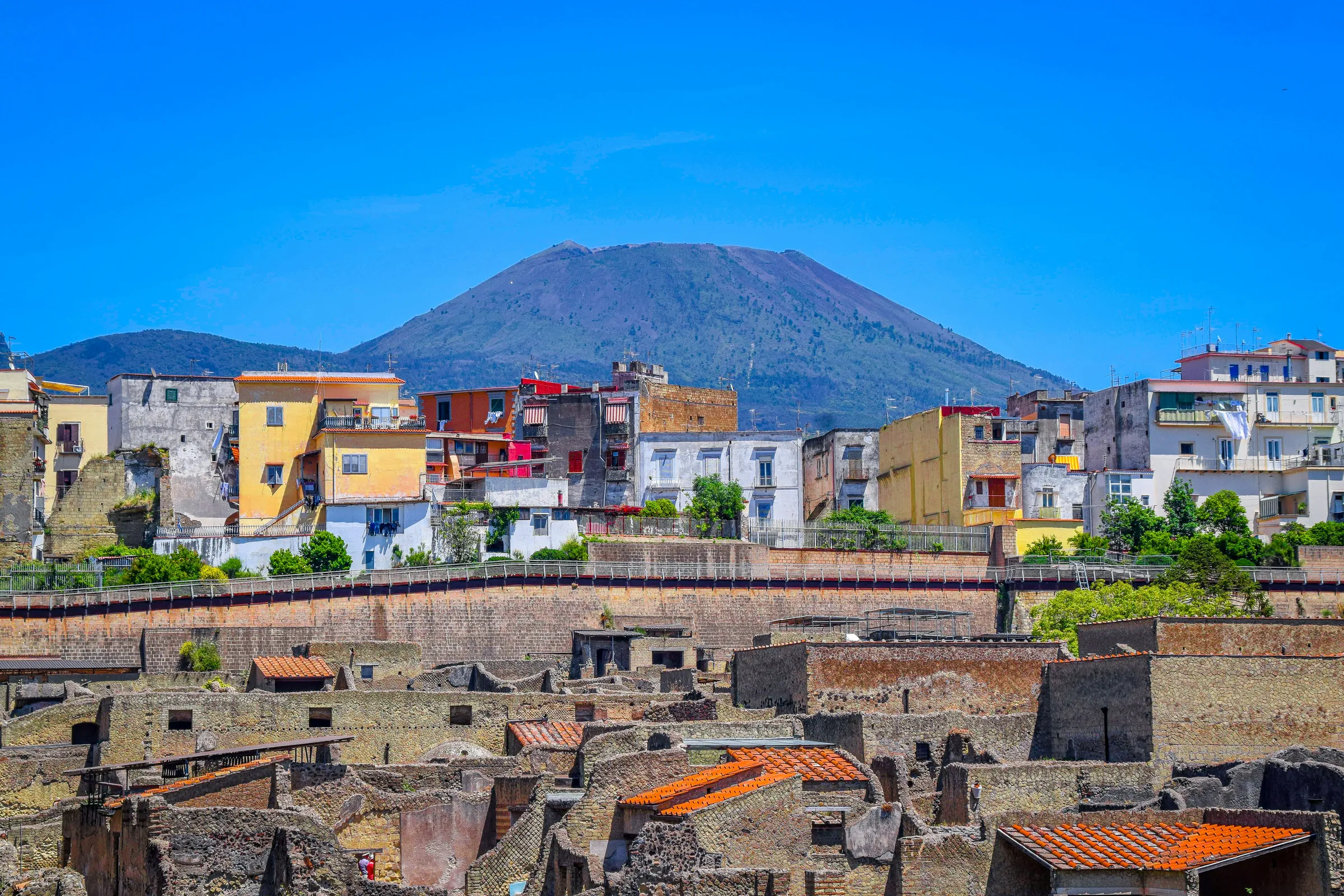
The town was organised on a regular Roman urban grid of intersecting streets — the Decumani running east-west and the Cardines running north-south — with the main civic buildings clustered around a Forum near the centre. The surviving excavated zone covers the south-western quarter of the town nearest the harbour, where the residential and commercial blocks survive in extraordinary condition. The northern and eastern quarters, including the Forum, remain largely buried beneath the modern town of Ercolano. The town's three main public bath complexes (the Forum Baths, the Suburban Baths, and a third complex partly buried) provide the densest urban bath provision known from any Roman town of comparable size, reflecting both the wealth of the population and the seaside-resort character. The detail is one of several where the gap between the published operator schedule and the lived experience inside the gate is wider than most travellers expect.
Domestic architecture at Herculaneum is the most distinctive feature of the surviving record. Houses survive up to three storeys where Pompeii preserves mostly ground floors, and the carbonised wooden interior fittings — partition screens, doors, balconies, furniture — are unique in the surviving Roman record. The largest houses (Casa di Nettuno e Anfitrite, Casa dei Cervi, Casa del Tramezzo di Legno) were substantial elite residences with reception rooms, private bath suites, and ornamental gardens; the smaller workshop houses along the secondary streets give us our clearest picture of how Roman urban tradespeople actually lived. The combination is unique in the surviving record of Roman urban life. The official archaeological park calendar is the single reliable source for date-specific confirmations and is updated promptly. The concierge team includes the relevant operator confirmation for every customer ahead of the visit so that no one arrives without the current information.
The AD 79 Destruction
Mount Vesuvius erupted on the afternoon of 24 October AD 79 (the traditional date of 24 August has been revised by recent scholarship based on charcoal evidence from the site). The eruption unfolded over roughly eighteen hours and affected Herculaneum and Pompeii in distinct phases. Pompeii, fifteen kilometres downwind to the south-east, was first showered with several metres of pumice and ash carried by the prevailing winds. Herculaneum, seven kilometres closer to the volcano on its western flank, was initially little affected by the ash fall because the wind blew the pumice column away from the town. The early hours of the eruption gave Herculaneum's inhabitants time to evacuate by sea or overland. The point matters at Herculaneum more than at many comparable sites because the excavated zone is genuinely compact and small operator decisions affect a higher fraction of the visit.
Most of Herculaneum's population appears to have escaped. The town's surviving record shows relatively few human remains in the residential areas — fewer than would be expected if a population of 5,000 had been buried in their homes — and the harbour district was found largely cleared of personal property as if the inhabitants had taken time to pack before evacuating. The dramatic exception is the Boatsheds along the ancient shoreline, where around three hundred citizens had taken shelter from the surge while waiting for evacuation boats. They were killed where they stood when the first pyroclastic flow arrived overnight. The Boatsheds discovery in the 1980s is one of the most emotionally direct human encounters available at any Roman archaeological site. The handful of customers who have asked us about this detail in the past year have all reported a smoother visit once they understood it correctly in advance.
The pyroclastic flows themselves arrived in sequential surges through the early morning hours of 25 October, depositing a final cover of roughly twenty metres of solidified volcanic material across the entire town. The flows were superheated — temperatures around 500°C — which carbonised organic material rather than burning it away, and which is the single reason Herculaneum preserves the wooden interiors, the carbonised library, the loaves of bread on the baker's counter, and the food still in the cooking pots. The depth of the burial made Herculaneum almost impossibly hard to excavate by 18th-century methods, which is why so much of it still lies buried beneath the modern town. The trade-off is the unique state of preservation in what has been excavated. The standard concierge confirmation email includes the relevant operator-side detail so that no traveller arrives at the Corso Resina gate without the current information.
Rediscovery and the Bourbon Tunnels
Herculaneum was rediscovered by accident in 1709 during well-digging works for the Prince of Elbeuf, a French nobleman building a country villa above the buried town. The well-diggers broke through into one of the buried rooms and recovered a number of marble fragments that the prince took for his private collection and that eventually attracted the attention of the Bourbon royal court at Naples. The first systematic excavation began in 1738 under Charles III of Bourbon, who had become King of Naples in 1734 and saw the buried town as a major opportunity to enhance the prestige of his new court. The Bourbon excavations at Herculaneum predate the Pompeii excavations by ten years and are the foundation of modern European archaeology. The concierge confirms current operator policy for every customer before booking and emails a date-specific reminder with the printable PDF ticket attached.
The Bourbon excavators worked by tunnel rather than open excavation, because the depth of the buried material (roughly twenty metres of consolidated pyroclastic stone) made open-cut excavation prohibitively difficult. The Swiss military engineer Karl Weber, who took over the work in 1750, mapped the buried town through a network of tunnels that probed the main buildings systematically and that recovered enormous quantities of marble sculpture, bronze statuary, frescoes lifted from the walls, and the carbonised library of the Villa of the Papyri. The Weber map remains one of the foundational documents of European archaeology and was the basis for the architectural reconstruction at the Getty Villa in California. The tunnels were filled back in after the excavations to stabilise the buried town, and most of what Weber explored remains buried beneath the modern surface.
The Bourbon recoveries from Herculaneum form the core of the National Archaeological Museum in Naples (MANN), which holds the marble and bronze sculpture from the Villa of the Papyri, many of the frescoes lifted from the residential houses, and substantial collections of decorative arts from across the buried town. The Bourbon-period excavations were prestige projects oriented towards acquiring spectacular objects for the royal court rather than systematic archaeological investigation; many objects were removed without records of where they were found, and substantial damage was done to the buried buildings as the tunnels were extended. The modern archaeological understanding of the Bourbon recoveries continues to depend on detective work reconstructing find-spots from the surviving incomplete records. Most international visitors find this single detail makes the difference between an easy gate experience and a stressful one in the bright Mediterranean midday sun.
Maiuri, the Modern Excavations and the Boatsheds
Modern open-cut excavation at Herculaneum began in 1927 under Amedeo Maiuri, who served as Superintendent of Antiquities at Pompeii and Herculaneum from 1924 until 1961. Maiuri's open excavations replaced the Bourbon tunnels with systematic large-scale removal of the pyroclastic cover, exposing the residential zone in the form visible to modern visitors. The Maiuri excavations of the late 1920s and 1930s exposed the Casa di Nettuno e Anfitrite, the Casa del Tramezzo di Legno, the Suburban Baths, and the main Decumanus Maximus thoroughfare. Maiuri's working method emphasised careful documentation, in-situ preservation of organic material, and the architectural conservation of the exposed buildings — a sharp methodological contrast with the Bourbon recoveries. The detail matters because the operator's published rules change periodically and travel sources often lag the current operator schedule by several months. The Antiquarium multimedia displays cover this material in more depth and are worth thirty minutes either before or after the main excavated-zone visit.
Maiuri's work continued through the 1940s and 1950s with progressively larger excavations across the residential zone. The Casa dei Cervi was excavated in the 1930s; the Casa del Bel Cortile and the Casa dell'Atrio a Mosaico through the 1940s; the area around the College of the Augustales through the 1950s. Maiuri's tenure also saw the first serious conservation programme at the site, with substantial structural reinforcement of the standing buildings, restoration of the frescoes and mosaics, and the construction of the Antiquarium visitor centre. The Maiuri-era excavated zone — roughly the south-western quarter of the ancient town — remains the standard visitor experience today, supplemented by the targeted 1990s and 2000s excavations at the Villa of the Papyri. Plan to confirm current opening hours and closures via the official ticketing page in the fortnight before travel.
The most dramatic single discovery in the entire history of Herculaneum came in the 1980s. Excavations along the ancient shoreline — now well inland, the eruption pushed the coast outwards by several hundred metres — exposed a series of boatsheds (Fornici) at the harbour edge, and the boatsheds were found to contain the skeletal remains of around three hundred citizens who had taken shelter from the pyroclastic surge while waiting for evacuation boats. The Boatsheds discovery was the first substantial evidence that Herculaneum's population had not in fact escaped en masse by sea, and provided the first direct human evidence of the eruption's effect on the town's inhabitants. The remains are displayed in situ today at the Boatsheds and are the emotional core of any modern visit. The 1997 UNESCO inscription followed shortly afterwards, recognising the site's unique value as a single archaeological landscape preserving Roman urban life at the moment of the AD 79 eruption.
Frequently asked
When was Herculaneum founded?
Around 600 BCE, as a Greek colony probably founded from the older Greek colony at Cumae further north on the Campanian coast. The Greek name was Heraklea, reflecting the cult of Heracles that the founders brought with them. The town fell under Roman political control by around 89 BCE following the Social War, and was incorporated as a Roman municipium.
How big was Herculaneum compared to Pompeii?
Much smaller. Herculaneum's pre-eruption population was around 5,000 against Pompeii's roughly 20,000, and the excavated area is around a quarter of Pompeii's open footprint. But Herculaneum was wealthier per capita — surviving houses show much higher densities of marble flooring, mosaic decoration, imported sculpture, and multi-storey construction than at Pompeii. The town was a small wealthy seaside resort rather than a major regional commercial centre.
When was Herculaneum rediscovered?
In 1709, by accident during well-digging works for the Prince of Elbeuf above the buried town. The first systematic excavation began in 1738 under Charles III of Bourbon, predating the start of the Pompeii excavations by ten years. The Bourbon excavators worked by tunnel rather than open excavation because of the depth of the buried material — roughly twenty metres of consolidated pyroclastic stone.
Who was Amedeo Maiuri?
Amedeo Maiuri served as Superintendent of Antiquities at Pompeii and Herculaneum from 1924 until 1961 and led the modern open-cut excavations at Herculaneum from 1927 onwards. The Maiuri excavations of the late 1920s and 1930s exposed the main residential zone visible to modern visitors, including the Casa di Nettuno e Anfitrite, the Casa del Tramezzo di Legno, the Suburban Baths, and the Decumanus Maximus. His methodological emphasis on careful documentation and in-situ preservation shaped modern archaeological practice.
What is the Boatsheds discovery?
Excavations along the ancient shoreline in the 1980s exposed a series of boatsheds (Fornici) at the ancient harbour edge containing the skeletal remains of around three hundred citizens who had taken shelter from the pyroclastic surge while waiting for evacuation boats. The discovery was the first substantial evidence that Herculaneum's population had not escaped en masse by sea, and provides the first direct human evidence of the eruption's effect on the town. The remains are displayed in situ at the Boatsheds and are the emotional core of any modern visit.
When was Herculaneum inscribed by UNESCO?
In 1997, as part of the serial inscription 'Archaeological Areas of Pompei, Herculaneum and Torre Annunziata' (reference 829). The inscription covers Herculaneum, Pompeii itself, and the Villa Poppaea at Oplontis in Torre Annunziata. All three sites are managed by the Italian Ministry of Culture through the site authority as official ticketing operator. The UNESCO listing recognises the unique value of the Vesuvius-buried towns as a single archaeological landscape.
Why is so much of Herculaneum still buried?
Because the modern town of Ercolano sits directly above the buried Roman town and would have to be demolished to expose the unexcavated zones. The northern and eastern quarters of the ancient town, including the Forum, remain largely buried. The Villa of the Papyri extends substantially beyond the small area exposed by the 1990s excavations. The Italian Ministry of Culture has consistently prioritised conservation of what has already been excavated over further large-scale digs at the buried zones.