 Skip-the-line available
 The Best Time to Visit Herculaneum
When the Campanian heat is bearable, when the tour-group pressure thins, and when the light catches the glass-paste mosaic at Casa di Nettuno e Anfitrite at its best.
Herculaneum is open every day of the year except 1 January and 25 December, but that does not mean every day is a good day to walk it. The excavated zone sits well below the modern street level of Ercolano, surrounded by volcanic stone that absorbs and re-radiates heat through the long Campanian summer, and the gate queue and coat-check choke point are completely unshaded. Choosing when to come is the single biggest lever a visitor has over the quality of the day. This guide walks the calendar month by month, names the holidays that move crowd density up or down, and gives the concierge's honest pick of the four or five weeks where Herculaneum is at its best.
The Two Hard Limits — Heat and Crowd Days
Two operational facts shape every Herculaneum date decision, and neither is a weekly closing day — unlike Pompeii and many Italian state museums, Herculaneum is open every single day of the year except 1 January and 25 December, so any day of the week is bookable. The first real lever is crowd density: the first Sunday of every month is free state-museum entry across Italy, and on those days Herculaneum becomes uncomfortably crowded from opening — the concierge advice is to avoid first Sundays entirely. Italian public holidays (Easter Sunday, Pasquetta, Ferragosto on 15 August, and the long bridge weekends known as ponti) bring a sharp domestic surge that fills the compact excavated zone. The second lever is the seasonal hours switchover: the long summer schedule runs the gates to 19:30, but in the winter schedule the site empties by 17:00, so a late-afternoon winter arrival can leave too little time. Most international visitors find that picking the right day — a non-holiday weekday outside the first Sunday — makes the difference between an easy gate experience and a stressful one in the bright Mediterranean midday sun.
The second hard limit is the summer heat. From mid-June through early September the volcanic stone of the excavated zone absorbs sun all morning and re-radiates it into the afternoon, so the felt temperature inside the ruins runs well above the official reading from Naples airport. The cliff face above the excavated zone — formed by the twenty metres of consolidated pyroclastic material that buried the town — gives some welcome shade on the eastern side in the morning, but the western half and the Boatsheds along the ancient shoreline get the full sun load. Hydration is non-negotiable on hot days. The on-site fountains dispense potable water. The Antiquarium visitor centre is air-conditioned and works well as a midday cooling stop between the morning and the late-afternoon legs of a longer visit. The detail matters because the operator's published rules change periodically and travel sources often lag the current operator schedule by several months.
Combining the two constraints, the calendar splits into three rough zones. The shoulder months (April, May, late September, October) give comfortable temperatures, the long summer opening hours, manageable cruise-coach pressure, and the best chance of having the headline houses to yourself for ten or fifteen minutes around the opening. The high summer (mid-June through early September) gives the longest hours but the worst heat and the heaviest pressure from cruise day-trippers based at Naples and Sorrento. The cold months (November through March) give quiet ruins and beautiful low-angle light on the mosaics, but a shortened useful day from the 15:30 last-entry rule and the risk of wet paving in the excavated zone. The Antiquarium multimedia displays cover this material in more depth and are worth thirty minutes either before or after the main excavated-zone visit.
Month by Month — What Each Season Brings
January and February are quiet, cool by Campanian standards, and short. The 08:30 entry effectively gives you the city alone for the first hour, and the low winter sun catches the polychrome marble at the Casa dei Cervi and the glass-paste mosaic at the Casa di Nettuno e Anfitrite particularly well around 10:00. The trade-off is the early last entry of 15:30 and occasional heavy Mediterranean rain that turns the modern access ramps slippery. Some peripheral houses rotate closed for off-season conservation. These months suit visitors whose priority is contemplation and detail rather than the full headline circuit, and pair naturally with the Naples Archaeological Museum on adjacent days. The MAV next door remains open and works well as a winter morning alternative if the weather turns bad. Plan to confirm current opening hours and closures via the official ticketing page in the fortnight before travel.
March through mid-June is the prime window for most international visitors. Daytime temperatures rise gently, the long summer opening hours start in April, and the cruise season is gradually building but has not yet reached peak pressure. Italian Easter (Pasqua) brings a sharp domestic surge for the long weekend; on Pasquetta (Easter Monday) the park is open and busy, with the surrounding town in full festival mode. The first Sunday of each month is free state-museum entry across Italy and Herculaneum becomes uncomfortably crowded — the concierge advice is to avoid first Sundays entirely. Outside those flagged days, a Tuesday or Wednesday in late April or early May is, by a wide margin, the best single date most travellers can choose for a calm and visually rewarding Herculaneum visit. The MAV multimedia museum next door covers the same context with 3D reconstructions and is highly recommended as pre-visit framing.
Mid-June through early September is high summer and the hardest period. Cruise-coach pressure from Naples and Sorrento peaks, the Campanian heat is genuine, and Italian school holidays push domestic family visits up sharply. Ferragosto (15 August) is the national holiday weekend when Naples largely empties to the coast and Herculaneum sees concentrated short-stay traffic from holidaymakers. The 08:30 slot becomes non-negotiable in these months — arrive at opening, finish the main circuit by noon, retreat to a long lunch in the modern town, and use the cooler late afternoon for the air-conditioned Antiquarium and the Boatsheds. Carrying two litres of water per adult is the baseline, not the precaution. Heat exhaustion is treated daily at the first-aid station in midsummer. The detail is one of several where the gap between the published operator schedule and the lived experience inside the gate is wider than most travellers expect.
Mid-September through October mirrors May in temperature and visitor density but with markedly thinner cruise pressure as the European cruise season winds down. The last week of September and the first three weeks of October are the concierge's quiet favourite — comfortable warm days, calm crowds, and exceptional light on the Boatsheds in late afternoon when the sun catches the ancient shoreline. November and December close the year much as January opens it: quiet, short, and best suited to a focused two-hour visit on the main excavated zone rather than a full day with MAV and the surrounding sites. The park is closed on 25 December and 1 January and reopens on 2 January with the full winter schedule. The official archaeological park calendar is the single reliable source for date-specific confirmations and is updated promptly.
Free-First-Sunday and Other Crowd Pulses
Italian state museums and archaeological parks, including Herculaneum, offer free admission to all visitors on the first Sunday of every month under the Ministry of Culture's #DomenicaalMuseo policy. The intention is laudable and the consequence at Herculaneum is operationally difficult: free Sundays see queues at the Corso Resina entrance from before opening, the coat-check at the gate reaches capacity by mid-morning, and the headline houses (Casa di Nettuno e Anfitrite, Casa dei Cervi, Casa del Tramezzo di Legno) operate with shuffling crowds rather than walkable rooms. If your priority is the photographic and contemplative experience of Herculaneum, choose any Sunday except the first, or — better — choose a weekday. A concierge ticket on a non-free day buys you a calmer site than a free ticket on a heaving one. The concierge team includes the relevant operator confirmation for every customer ahead of the visit so that no one arrives without the current information.
School-group pressure is the other predictable wave. Italian school groups arrive Tuesday through Thursday mornings during term — broadly mid-September through mid-June with breaks at Christmas and Easter — and concentrate at the Casa di Nettuno e Anfitrite, the Boatsheds and the Antiquarium. They generally clear by early afternoon. Arriving for the 08:30 slot puts you ahead of them by an hour. Foreign coach tours peak on weekday mid-mornings from April through October, arriving from Naples and Sorrento between 10:00 and 11:30 and rotating between Herculaneum and Pompeii in roughly two-hour blocks. The cleanest visit window is the first hour after opening, before either wave arrives at the gate. The point matters at Herculaneum more than at many comparable sites because the excavated zone is genuinely compact and small operator decisions affect a higher fraction of the visit.
Specific event days move the dial too. Major Italian civic holidays (25 April Liberation Day, 2 June Republic Day, 1 November All Saints) push domestic visitors into the site. Cruise-ship arrivals at Naples and Salerno port concentrate coach tours on Tuesdays through Thursdays in summer. Conversely, the Naples San Gennaro feast (19 September) pulls visitors away from the Vesuvius sites and into the city centre, and can be a usefully quiet day at Herculaneum. The Italian summer holiday closure period in mid-August sees concentrated short-stay domestic visitors but a noticeable drop in cruise-coach foreign traffic, which can briefly improve the experience in the second half of August despite the heat. The handful of customers who have asked us about this detail in the past year have all reported a smoother visit once they understood it correctly in advance.
Light, Photography and the Mosaics
Herculaneum rewards photographers who think about light. The glass-paste mosaic of Neptune and Amphitrite at the Casa di Nettuno e Anfitrite — one of the finest in-situ examples of Roman wall mosaic anywhere — was designed to be seen by natural light entering through the open ceiling of the courtyard above. The vivid blues and greens of the glass paste read at their best when direct sunlight falls into the courtyard around mid-morning in summer and late morning in winter; eyes need a minute to adjust on entry. Tripods are restricted to permit holders; handheld photography with a fast lens is the practical approach. The marble statues at the Casa dei Cervi catch best around 11:00 in late spring and early autumn. The standard concierge confirmation email includes the relevant operator-side detail so that no traveller arrives at the Corso Resina gate without the current information.
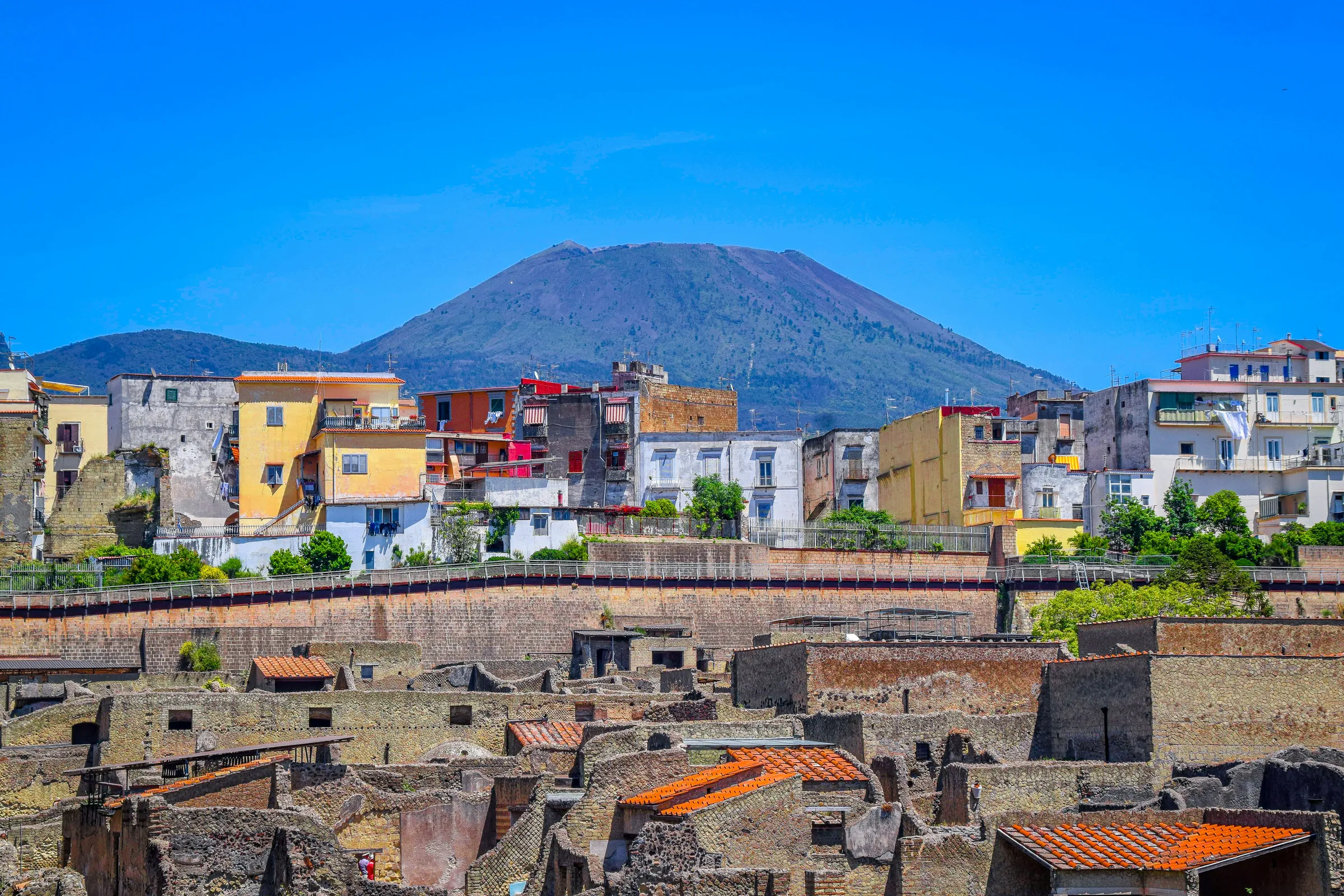
Outside, the canonical shot of the excavated zone from the upper viewing terrace above the Corso Resina entrance — the long horizontal slice of the Roman town with the modern Ercolano above it and Mount Vesuvius in the background — is best in the first hour after opening, when the eastern sun catches the polychrome stonework cleanly without the harsh midday flatness. The Boatsheds along the ancient shoreline get harsh midday sun and read best early or late; the afternoon light on the carbonised wooden balconies above the Decumanus Maximus is photographically strong from around 16:00 in summer. October and November overcast mornings are quietly excellent for the interior frescoes and mosaics, which read at their best without direct sunlight bleaching the colours. The concierge confirms current operator policy for every customer before booking and emails a date-specific reminder with the printable PDF ticket attached.
Closures, Hours, and What to Confirm Before You Travel
Herculaneum is open every day of the year except 25 December and 1 January, including Easter Sunday, Easter Monday (Pasquetta) and Ferragosto. There is no weekly closing day. Opening time is consistently 08:30 across the year. Last admission via the Corso Resina entrance is 18:00 in the summer schedule (1 April to 31 October) and 15:30 in the winter schedule (1 November to 31 March), with the gates closing at 19:30 and 17:00 respectively. The summer-winter switchover happens at the calendar boundaries and is normally aligned with the European daylight-saving change. There is no continuous-entry restriction or fixed time-slot system as at some other Italian sites — your skip-the-line ticket is valid for entry at any point during opening hours on your booked date. Most international visitors find this single detail makes the difference between an easy gate experience and a stressful one in the bright Mediterranean midday sun.
Three things to confirm in the week before travel: current daily opening and last-entry times for your specific date (these can shift around major Italian holidays), whether any of the headline houses you most want to see are temporarily closed for conservation (the official site lists current closures), and whether your date is a free-first-Sunday. The official park site the official site publishes all three. A visit planned around these three variables is a visit that delivers what Herculaneum can deliver; one that ignores them is the visit that ends with a 90-minute queue at the gate, a roped-off Casa dei Cervi, and a too-short afternoon before the gates close. The concierge confirms all three for every customer before booking and sends a date-specific reminder 48 hours before the visit. The detail matters because the operator's published rules change periodically and travel sources often lag the current operator schedule by several months.
Frequently asked
What is the best month overall to visit Herculaneum?
Late April through mid-May, or the last week of September through the first three weeks of October. These windows give comfortable daytime temperatures, the long summer last-entry schedule, manageable cruise-coach pressure, and avoid both the worst summer heat and the winter early-close. A Tuesday or Wednesday outside Italian school holidays is the concierge's pick.
Is Herculaneum open on Mondays?
Yes. Herculaneum is open every day of the week, Mondays included. A common misconception is that it follows the old Italian state-museum convention of closing on Mondays, as some sites do — but the Parco Archeologico di Ercolano is open every single day of the year except 25 December and 1 January. You can confidently book any Monday. The official opening time is 08:30, with last admission at 18:00 in summer and 15:30 in winter.
Should I avoid the free first Sunday of each month?
Yes, if a calm photographic experience matters to you. First Sundays bring free state-museum entry across Italy under the Ministry of Culture's #DomenicaalMuseo policy, and Herculaneum becomes uncomfortably crowded — queues at the Corso Resina gate from before opening, capacity reached at the coat-check by mid-morning, and the headline houses operating in shuffle mode. Choose any other Sunday or a weekday.
How bad is Herculaneum in July and August?
Hot, crowded, and demanding. Felt temperatures inside the excavated zone run well above the official Naples air reading, the gate queue and coat-check are completely unshaded, and the park's first-aid station treats real heat-exhaustion cases on summer days. If summer is your only option, take the 08:30 opening, carry at least two litres of water per adult, finish the main circuit by noon, and use the air-conditioned Antiquarium for the hot mid-afternoon.
When does the site close in winter versus summer?
Opening is 08:30 year-round. Last admission is 18:00 in the summer schedule (1 April to 31 October) and 15:30 in the winter schedule (1 November to 31 March), with the gates closing at 19:30 and 17:00 respectively. The official park website publishes the exact dates each year — confirm the schedule for your specific visit date before booking. The switchover is normally aligned with European daylight saving.
Which day of the week is quietest?
Sunday afternoons and Friday afternoons tend to be the quietest within any given week (outside the free first Sunday), because the school-group wave has cleared and the coach-tour day-tripper traffic has rotated to other Bay of Naples sites for the late afternoon. Tuesday through Thursday mornings are the busiest with combined school and cruise traffic during term.
What time of day gives the best mosaic photographs?
Mid-morning for the glass-paste mosaic of Neptune and Amphitrite at the Casa di Nettuno e Anfitrite — direct sunlight falls into the open courtyard around 10:00 to 11:00 in summer and slightly later in winter, lighting the vivid blue and green glass at its best. The Boatsheds and the carbonised wooden balconies above the Decumanus Maximus photograph strongly in late-afternoon light from around 16:00.
Are any houses closed when I visit?
Likely yes. With dozens of frescoed and decorated houses on rotation for conservation, a handful are always closed and a handful have just re-opened. The official site the official site publishes the current list. Major recent openings include the restored Casa dei Cervi; recent closures rotate. Check within a fortnight of your travel — the concierge confirms current closures for every customer.
Is Herculaneum open on Italian holidays like Easter and Ferragosto?
Yes. Herculaneum is open on Easter Sunday, Pasquetta (Easter Monday) and Ferragosto (15 August). These are among the busier days in the calendar because Italian families travel domestically. If you want a quieter site, choose a date adjacent to but not on these holidays. The park is closed only on 25 December and 1 January, and is open every other day of the year.